Opening Summary
A viral post recently turned the racial wealth gap into a blunt comparison: for every $100 in wealth held by a White family, Asian families hold more, Hispanic families hold far less, and Black families hold the least. The post warned Black America to shift from consuming to owning. The warning landed because the core wealth-gap numbers are largely real. But the deeper lesson requires cleaner language.
Black America does not simply have a spending problem. Black America has a capital-retention problem, an asset-ownership problem, an inheritance problem, a housing-return problem, a business-equity problem, and a systems problem.
The economy sees Black America clearly when it is time to sell. It sees Black people as viewers, workers, voters, renters, borrowers, fans, patients, students, consumers, creators, and cultural engines. But the balance sheet tells a different story: Black America moves markets without owning enough of the markets it moves.
The wealth-gap math is not imaginary
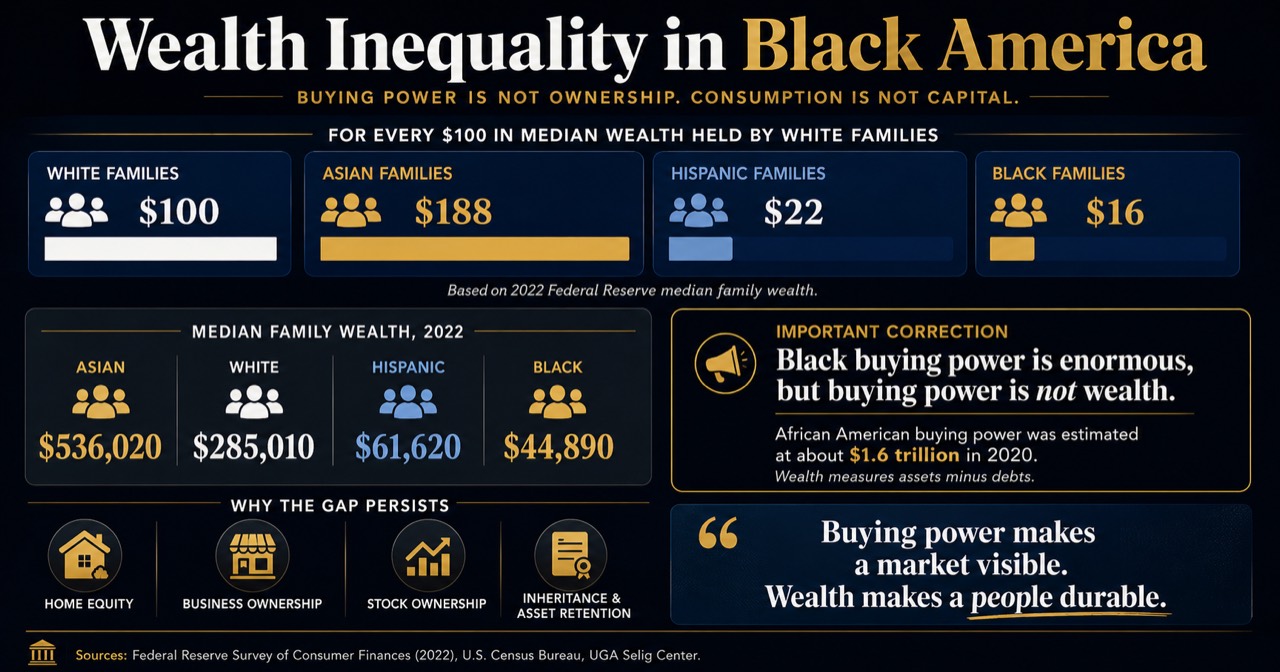
The Federal Reserve's 2022 Survey of Consumer Finances shows why the post spread so quickly. In 2022, the median White family had about $285,010 in wealth. The median Black family had $44,890. The median Hispanic family had $61,620. The median Asian family had $536,020. The 2022 SCF separated Asian families for the first time because of an Asian-family oversample, so that comparison is new and should be read with care.
Converted into the viral per-$100 format, Asian families held about $188 in median wealth for every $100 held by White families. Hispanic families held about $22. Black families held about $15.75, which rounds to $16. The viral claim was close on the Black figure, but nearest-dollar rounding gives $16 rather than $15.
The viral claim, corrected
The ratios below use 2022 Federal Reserve median family wealth. Median wealth is not average wealth; it is the midpoint household balance sheet after assets and debts are counted.
| Claim | CultureUp reading | What the public data supports |
|---|---|---|
| Asian families have $188 for every $100 held by White families | Accurate with a caveat | The 2022 Fed SCF median wealth figures produce about $188 per $100 of White median wealth, but Asian American wealth is internally diverse and the SCF separated Asian families for the first time in 2022. |
| Hispanic families have $22 | Accurate as rounded | The 2022 Fed SCF median wealth figures produce about $22 per $100 of White median wealth. |
| Black families have just $15 | Close but rounded down | The 2022 Fed SCF median wealth figures produce about $15.75 per $100 of White median wealth, which rounds to $16. |
| Black America spends between $1.2 trillion and $18 trillion a year | Misleading as written | $18 trillion is not Black annual spending. It is closer to the scale of total U.S. buying power in earlier Selig Center estimates. African American buying power is enormous, but it should not be confused with total U.S. buying power or retained wealth. |
Buying power is not wealth
One correction matters more than all the others: buying power is not wealth.
The University of Georgia's Selig Center defines consumer buying power as total income after taxes. That is money available to spend, save, invest, give, lend, or lose. It is not the same as assets minus debts. In 2020, Selig estimated African American buying power at about $1.6 trillion, or roughly 9% of U.S. buying power. That is enormous market power, but it is not the same as owned homes, appreciated land, equity in businesses, retirement assets, stocks, insured assets, patents, catalog rights, or inherited capital.
The cleaner argument is this: Black America has trillion-dollar consumer power, but too little of that power is converted into durable Black-owned assets. Buying power is the river. Wealth is the reservoir.
Buying power makes a market visible. Wealth makes a people durable.
The balance sheet carries the history
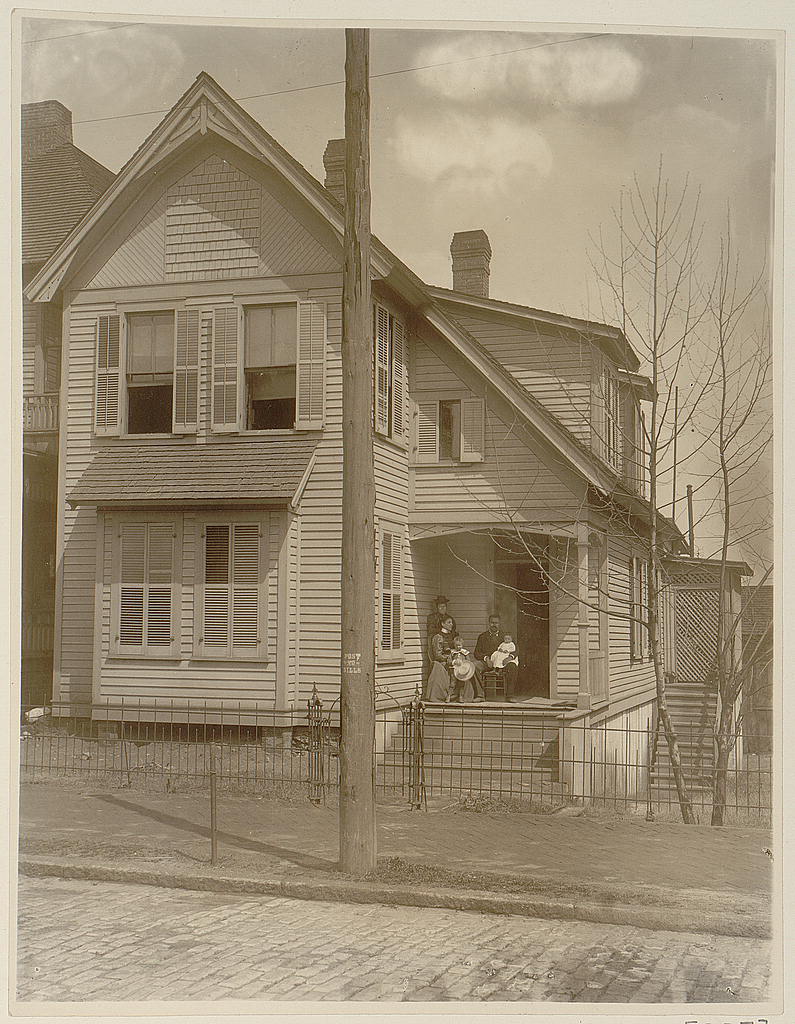
Wealth is not only money. Wealth is memory with legal protection. It is the deed that stayed in the family. The home that appreciated. The business that survived succession. The pension that vested. The land that was not partitioned, stolen, undervalued, taxed away, or captured through paperwork. The insurance policy that paid out. The school district funded by property values. The inheritance that arrived before the crisis instead of after the funeral.
The U.S. Census Bureau's 2021 SIPP analysis gives the balance-sheet picture in another form. Households with a White non-Hispanic householder made up 65.3% of U.S. households but held 80.0% of household wealth. Households with a Black householder made up 13.6% of households but held only 4.7% of wealth. The median Black household had $24,520 in wealth, about one-tenth the $250,400 median for White households in that survey.
That is why the wealth gap cannot be reduced to one lecture about consumer habits. A household cannot save its way into equal wealth if its income is lower, its debt burden is higher, its home is appraised lower, its credit costs more, its family inherits less, its business is undercapitalized, and its neighborhood receives weaker public and private investment.
Assets decide who keeps the gains
The Federal Reserve's 2022 data shows the asset problem plainly. White families owned homes, stocks, and businesses at higher rates than Black families. Even when Black families owned assets, the typical values were often lower.
Among families that owned homes, the typical White family's net housing wealth was about $205,370 in 2022 compared with about $123,000 for Black families. Among families that owned stocks, the typical White family's stock value was about $67,970 compared with about $17,180 for Black families. Among families that owned businesses, the typical White family's business value was about $105,000 compared with about $41,700 for Black families.
That is the ownership gap beneath the consumer story. The problem is not merely that money leaves Black hands. The problem is that too much of the asset structure receiving that money is controlled elsewhere. Rent goes to owners. Interest goes to lenders. Consumer spending goes to companies. Platform traffic goes to platforms. Cultural attention goes to distributors. Labor goes to employers. The transaction may include Black people at the point of sale while excluding Black families at the point of equity.
Immigrant wealth shows what residence can become
Immigrant economic data adds an important lesson, but it must be handled carefully. Immigrants are not one group. Black immigrants, Asian immigrants, Latino immigrants, European immigrants, refugees, students, asylum seekers, high-wage professionals, service workers, undocumented workers, and naturalized citizens do not arrive with the same resources or face the same barriers.
Still, the data shows a pattern: when immigrant families establish residence in America, buying power, business ownership, housing participation, and wealth can grow with time, legal stability, education, family strategy, and access to asset markets. Residence can become capital when it is paired with time and a path to ownership.
The Migration Policy Institute reported that in 2024 the United States had more than 50.2 million immigrants, about 14.8% of the population. The American Immigration Council estimated that immigrant households in 2022 had about $2.1 trillion in combined household income, paid about $382.9 billion in federal taxes and about $196.3 billion in state and local taxes, and retained about $1.6 trillion in spending power.
But the wealth story is not simple. Pew Research Center found that immigrant households had a median net worth of $104,400 in 2021, below the $177,200 median for U.S.-born households. Time in the United States mattered: immigrants who arrived before 1979 had median household wealth of $261,700, almost seven times the wealth of immigrants who arrived in 2009 or later. U.S.-born people with immigrant parents had median wealth of $162,900, much higher than immigrant households overall and closer to other U.S.-born households.
That does not mean immigrant wealth automatically surpasses long-rooted American wealth. It means residence has an economic life cycle. Arrival is one balance sheet. Establishment is another. Citizenship, language, education, professional credentials, family networks, homeownership, entrepreneurship, neighborhood choice, and access to financial markets can change what a household is able to keep.
Black immigrants are part of Black America, but they do not erase the older wound
Black America itself is changing. Pew Research Center reported that the U.S. Black immigrant population reached 5.6 million in 2024, more than double its 2000 level. Black immigrants were about 11.4% of the total U.S. Black population and 11.2% of all U.S. immigrants. African-born Black immigrants and Caribbean-born Black immigrants each accounted for about 44% of the Black immigrant population.
Black immigrant households also carry economic power. The American Immigration Council reported that in 2021, Black immigrant households generated $153 billion in income, paid $39 billion in taxes, and held $114 billion in spending power.
This does not mean Black immigrants are outside Black America. It also does not mean Black immigrant success can be used to dismiss the long-rooted Black American wealth injury. Both truths must stand together. Black immigrants are part of the present and future of Black America. Long-rooted Black American families carry a distinct history of American racial wealth extraction. Those histories touch, overlap, and sometimes merge, but they should not be flattened into one careless category.
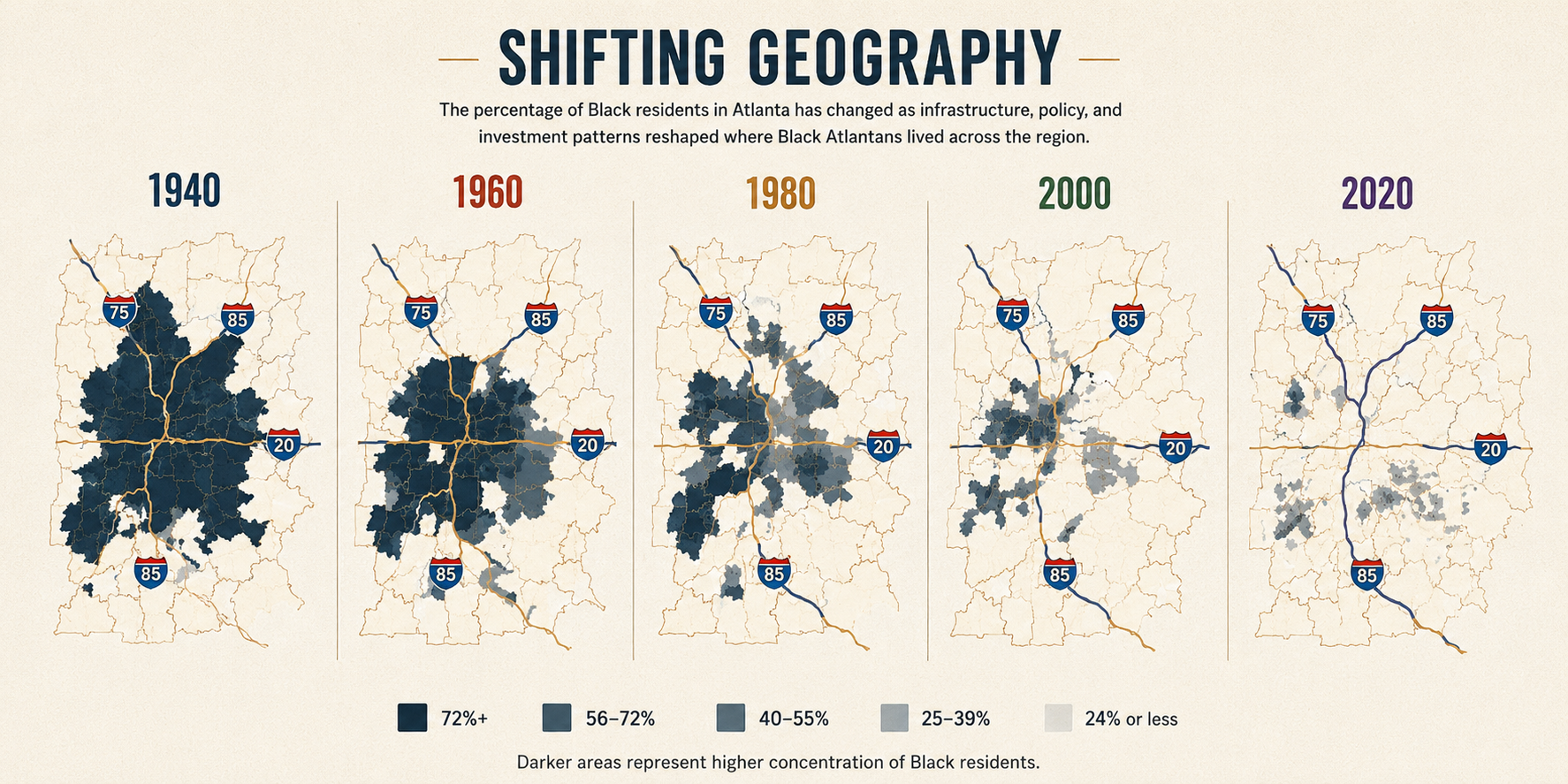
For CultureUp, the immigrant comparison is not an off-lane detour. It is a way to clarify what wealth requires: time, protected residence, institutional access, business formation, home equity, financial inclusion, public services, and intergenerational continuity. If those mechanisms help immigrant families build over time, then the long denial, extraction, and undervaluation of those same mechanisms in Black American communities must be treated as a central wealth question, not a side issue.
The real shift is from market visibility to balance-sheet power
The slogan shift from consuming to owning is useful, but incomplete. Black people cannot simply be lectured into wealth while the structure of wealth remains unequal. The issue is not whether Black families buy sneakers, phones, hair products, cars, streaming subscriptions, cosmetics, groceries, concert tickets, fashion, holiday gifts, or school supplies. Every group consumes. Consumption is not the scandal. The scandal is that Black consumption so often enriches systems Black people do not own.
The shift must be deeper than personal restraint. It must become a balance-sheet strategy. Black America needs more ownership of land, homes, businesses, media, supply chains, intellectual property, financial assets, retirement accounts, technology platforms, farms, publishing infrastructure, cultural archives, schools, clinics, grocery corridors, churches with development capacity, credit unions, investment funds, and community-controlled institutions.
The goal is not simply to buy less. The goal is to own more of what Black people already make valuable.
A Black wealth agenda must be institutional, not only individual
A serious Black wealth agenda begins with financial literacy but cannot end there. Literacy without capital is awareness without leverage. Capital without institutions is fragile. Institutions without memory become generic. Memory without ownership becomes vulnerable.
First, protect existing Black assets. That means estate planning, clean title, wills, trusts, probate cleanup, deed protection, insurance review, and legal defense against predatory land and home loss. The first wealth strategy is not always acquisition; sometimes it is stopping the leak.
Second, increase Black ownership of appreciating assets. Homeownership is not the only path and it carries risk, but housing equity remains central to American wealth. Stock ownership, retirement accounts, business equity, productive land, and intellectual property also matter because wealth grows when assets appreciate without requiring every dollar to come from wages.
Third, build Black business capacity beyond symbolism. Black-owned firms need customers, but they also need bookkeeping, credit, procurement access, legal structure, succession plans, insurance, technology, distribution, inventory financing, and patient capital. A purchase is support. A contract is stronger. Equity is stronger still.
Fourth, turn Black cultural influence into Black intellectual property. Black America drives music, fashion, language, visual culture, sports, beauty, food, politics, and digital trends. But influence without ownership becomes extraction. The question is not only who performs the culture. The question is who owns the masters, trademarks, catalogs, platforms, data, archives, venues, festivals, studios, and distribution systems.
Fifth, distinguish buying power from wealth in public language. Buying power can attract advertisers. Wealth can protect families. Buying power makes a market visible. Wealth makes a people durable.
How this story should be read
This story belongs on CultureUp because wealth is public memory. It determines whether a family can stay in place, keep a home, protect a church, maintain a cemetery, operate a business, preserve an archive, sponsor a school, fund a youth program, survive a medical crisis, or pass land to the next generation.
The CultureUp frame is not generic economic commentary. It is Black American continuity. The balance sheet decides whether memory has a roof, a deed, a title, a record, a business address, a burial ground, a church account, a neighborhood institution, or only a story told after the asset is gone.
The bottom line
The wealth gap is not just a statistic. It is a map of what America rewarded, what it extracted, what it protected, and what it left exposed.
Black America has buying power. Black America has labor power. Black America has cultural power. Black America has political power in key cities, counties, states, and national elections. Black America has memory, land, churches, schools, neighborhoods, archives, businesses, families, and names that survived more than any spreadsheet can measure.
But survival is not the same as ownership. The next phase cannot be only representation, visibility, or inclusion in someone else's market analysis. The next phase must be retained wealth, protected assets, controlled institutions, family continuity, local capital, and ownership structures that do not vanish when the trend changes.
The economy already knows Black America can spend. The question now is whether Black America will build, own, inherit, and keep.
Correction Path
Readers who know stronger public sources, local credit-union data, Black-owned business records, housing-equity studies, immigrant wealth studies, or corrections to the figures used here should send them through the CultureUp correction path. Approved updates should revise the public source trail rather than stretching any statistic beyond what it supports.