Atlanta's homelessness crisis is usually discussed as a housing problem, a mental-health problem, a public-safety problem, or a downtown-management problem. Those words are not always wrong. But they are incomplete.
A person does not usually become homeless because one thing happened. A rent increase, a demolished apartment complex, a death in the family, a missed medication appointment, an eviction filing, a hospital discharge, a public-housing relocation, a property-tax jump, or a caregiver's death may each look separate in the paperwork. In real life, they often gather.
In Black Atlanta, they may gather around one larger event: the remapping of Black place.
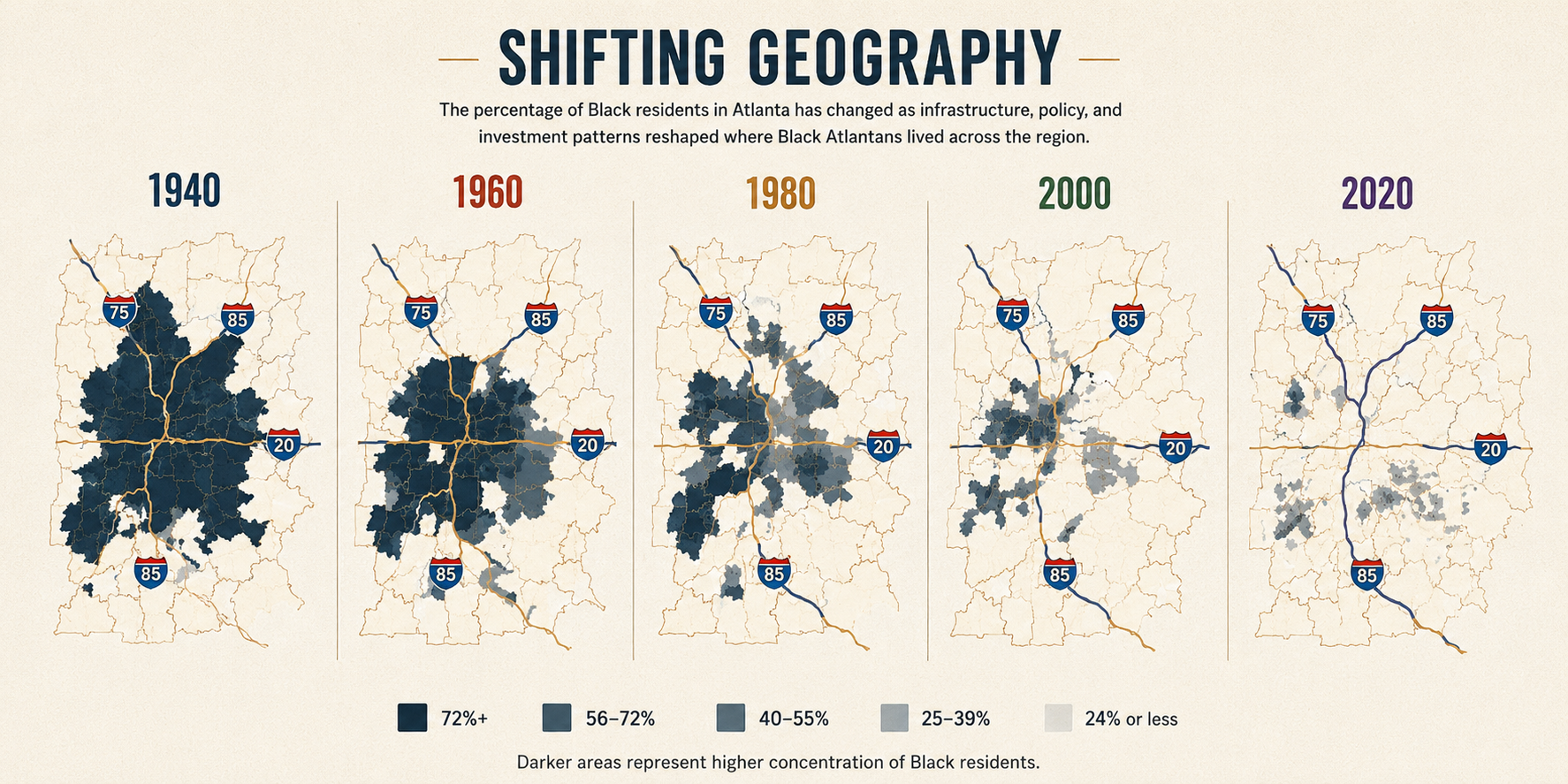
CultureUp has already named this larger movement in The Great Remapping of Black Atlanta: Black Atlanta did not simply decline. It regionalized. The older city map — Auburn Avenue, the Atlanta University Center, Bankhead, Mechanicsville, Pittsburgh, Summerhill, Vine City, English Avenue, Peoplestown, Cascade, Adamsville, East Point, College Park, Decatur, Stone Mountain, South DeKalb, South Fulton, Clayton County and beyond — changed under pressure from redevelopment, reinvestment, public housing policy, rising land values, investor activity, transportation corridors, family networks, and suburban expansion.
Black Atlanta did not simply disappear. It remapped. Now Atlanta has to answer for the people left outside when the map moved.
The public-data boundary
This article uses broad public racial labels only where the source data uses them. Homelessness datasets, Census tables, housing studies, and public policy reports do not verify lineage, ancestry, local family continuity, tribal identity, nationality, private family history, or community standing.
That limit matters. CultureUp is not claiming that every Black person experiencing homelessness in Atlanta is long-rooted Indigenous Black. The narrower and stronger claim is that Atlanta’s homelessness crisis should be studied as a displacement-to-homelessness pathway, especially where Black housing stability depended on family, elder, church, block, neighborhood, and place-based support systems.
The public data can show racial disproportionality, housing pressure, neighborhood change, rent burden, displacement risk, and homelessness counts. It cannot name every broken household, every lost caregiver, every vanished back room, or every church relationship that once kept someone indoors.
The racial imbalance is too large to ignore
The Atlanta Point-in-Time Count is federally mandated and conducted as an annual, unduplicated one-night count during the last ten days of January. Partners for HOME warns readers not to treat it as an exact number, but as an estimate that can show characteristics and change over time.
Even with that limitation, the pattern is stark. In the 2025 count, officials counted 2,894 people experiencing homelessness in Atlanta, up 1% from the prior year, with 1,061 people counted as unsheltered. In 2024, the National Alliance to End Homelessness reported that 36% of Atlanta's counted homeless population was unsheltered and that Black residents were about 47% of the city population while 83% of people experiencing unsheltered homelessness were Black.
Census QuickFacts places Atlanta's 2025 estimated population at 529,110, Black alone at 46.0%, and median gross rent for 2020–2024 at $1,711. The numbers do not explain the crisis by themselves, but they tell us where not to look away.
The older evidence already warned us
The 2018 SPARC Atlanta racial-equity report looked at Atlanta Continuum of Care HMIS data from fiscal years 2011 through 2016. It found that Black residents were 53.5% of Atlanta's general population, 75.7% of people living at 50% of the poverty line, and 87.5% of people represented in HMIS homelessness data.
The report was blunt about the meaning of that gap: poverty alone did not explain the overrepresentation of Black people in homelessness. Its qualitative findings named pathways into homelessness that included network impoverishment, threats to safety, unmet health needs, trauma, medical issues, and ineffective behavioral-health systems.
Network impoverishment is one of the keys to Atlanta. A person may technically have relatives. But if every relative is also rent-burdened, displaced, evicted, medically overwhelmed, underemployed, grieving, or living in a crowded apartment, then the family safety net is not a net. It is a thin sheet already tearing.
The map moved before the person fell
Displacement is often described as a household moving from one neighborhood to another. But CultureUp has to ask a more human question: what happens to the people whose housing was not a lease, but a relationship?
The person sleeping in a back room. The cousin on the couch. The adult son with untreated mental illness living with his mother. The uncle whose disability check helped with groceries but not enough to rent his own apartment. The grandmother who kept everyone stable until her house was sold. The woman who survived domestic violence because a church member let her stay for a while. These are housing arrangements, care arrangements, mental-health arrangements, and Black survival arrangements.
A city can destroy them without ever naming them. A redevelopment plan may say mixed-use. A property record may say sale. An eviction filing may say dispossessory. A public-housing document may say relocation. A tax assessment may say increased value. But inside the household, the sentence may be simpler: there is no room for you anymore.
Atlanta's displacement record is not imaginary
The displacement pressure behind this theory is well documented. NCRC reported that metro Atlanta ranked fourth among metropolitan areas where gentrification eliminated majority-Black census tracts from 1980 to 2020. Out of 31 majority-Black tracts in 1980, 42% no longer fell into that category by 2010. From 1980 through 2020, NCRC reported that 22,149 Black residents were displaced from 16 majority-Black census tracts.
The Urban Displacement Project found that nearly half of Atlanta neighborhoods experienced rapid housing-cost increases between 2000 and 2017. It also found that about 80,000 low-income Atlanta households lived in low-income neighborhoods at risk of, or already experiencing, gentrification and/or displacement. On the westside of the BeltLine, lower-income majority Black and Latinx areas were experiencing rising housing costs, gentrification, and displacement.
The City of Atlanta's own Neighborhood Change Report found that more than one-third of residents lived in neighborhoods that experienced substantial change from 2010 to 2018. The most common category was Growth and Low-Income Displacement. Those neighborhoods saw a decline in Black residents accompanied by an increase in white residents and residents with higher median incomes.
This does not prove that every person on an Atlanta sidewalk was displaced by gentrification. But it does show that Atlanta has experienced the exact kinds of housing, racial, and neighborhood changes that can break fragile households.
The old public-housing map matters too
Atlanta's homelessness story cannot be separated from public housing. Public housing was never just a set of buildings. In Black Atlanta, it was also a map of kinship, school routes, informal childcare, church relationships, street economies, food sharing, conflict, danger, protection, and familiarity.
When those buildings were demolished, redeveloped, or transformed through mixed-income policy, the official story often focused on physical conditions, relocation tools, or new development models. Some households found better conditions. Some escaped danger. Some used the move to build a new life. The story cannot be flattened into nostalgia.
CultureUp's question is different: what happened to the people whose names were not centered in the redevelopment narrative? Being known matters: a neighbor who knows when someone is off medication, a grandmother who knows which cousin is safe, a church mother who notices absence, a block where people know a person's name before they know his diagnosis.
Mental health is not the whole cause
Atlanta's homelessness debate often reaches for mental health as if mental illness itself explains the street. That is too easy. A person can live with schizophrenia, depression, addiction, or chronic illness and remain housed if the household is stable, the medication is accessible, the caregiver is alive, the rent is manageable, and the neighborhood network still functions.
Mental health becomes homelessness when the support structure around it collapses. That is why the SPARC findings matter: the report did not reduce Black homelessness to individual pathology. It connected homelessness pathways to network impoverishment, unmet health needs, trauma, medical issues, and weak behavioral-health access.
The question is not only what is wrong with a person. The question is what the city broke around them.
A working theory: the displacement-to-homelessness pathway
CultureUp names this as the displacement-to-homelessness pathway: the process by which neighborhood change, housing pressure, eviction, redevelopment, public-housing relocation, investor ownership, rising taxes, or rent burden breaks the household and care networks that kept vulnerable Black residents housed.
It does not always happen quickly. A family may first leave the old neighborhood. Then the vulnerable relative stays behind. Then the caregiver dies. Then the house is sold. Then the room disappears. Then the person doubles up somewhere else. Then that household gets evicted. Then the person enters an extended-stay hotel. Then the disability check is not enough. Then the medication lapses. Then the person is in Grady, jail, a shelter, a camp, or under a bridge.
What Atlanta should be measuring
If Atlanta wants to understand Black homelessness honestly, it has to collect more than a current sleeping location. It needs to ask where the person last had stable housing, whether that address was in a displacement-pressure area, who last helped them stay housed, and whether health care, disability benefits, medication, transportation, or documentation broke at the same time.
Questions for a displacement-to-homelessness source trail
These are editorial research questions, not a public request to expose private client data.
| Research question | Why it matters |
|---|---|
| Where did the person last have stable housing? | The current encampment or shelter location may hide the neighborhood where housing stability was lost. |
| Was the last stable address in a displacement-pressure area? | Eviction filings, investor purchases, rising assessments, redevelopment zones, and public-housing relocation can be compared without exposing private identities. |
| Who was the last person or household that helped them stay housed? | A caregiver death, family eviction, elder displacement, or doubled-up household collapse may be the real point of rupture. |
| Did health, disability, medication, transportation, or documentation access break at the same time? | Housing loss and health-system interruption often reinforce each other. |
The public record can test this theory. Current homelessness outreach geography, last stable housing addresses when voluntarily provided and privacy-protected, eviction filings, investor property purchases, public-housing relocation records, tax assessment changes, code enforcement, BeltLine and redevelopment zones, shelter intake pathways, hospital and jail discharge patterns, extended-stay hotel displacement, transit access, and permanent supportive housing placements can all help reconstruct the pathway.
A city cannot sweep what it has displaced
Atlanta has often treated visible homelessness as something to manage, clear, move, shelter, or contain. But if visible Black homelessness is partly an afterimage of Black displacement, then clearing encampments without understanding the displacement history repeats the injury in a new form.
The National Alliance to End Homelessness noted that Atlanta still has a camping or sleeping outside ban. Even when people are not arrested, forced relocation can strain relationships with outreach workers and make it harder for people to reach permanent housing.
Permanent supportive housing matters. Rental assistance matters. Outreach matters. Behavioral health matters. Eviction prevention matters. But so does memory. So does neighborhood. So does knowing whether a person was once held by a Black household, a Black block, a Black church, a Black grandmother, a Black housing complex, a Black school route, a Black bus line, a Black public world that has now been scattered.
The people inside the afterimage
There are people in Atlanta who look, to the passing city, like they appeared from nowhere. They did not. They came from households, blocks, apartments, public housing, family homes, shelters after evictions, hospitals, jails, couches, extended-stay rooms, and neighborhoods whose names still live in their mouths even when the buildings no longer do.
Some came from the Black Atlanta that developers now sell as location. Some came from the Black Atlanta that was priced out before it could be protected. Some came from the Black Atlanta that moved outward and survived. Some came from the part of Black Atlanta that moved, but could not carry everyone.
The question is not only why Atlanta has homelessness. The question is what Atlanta broke, who it left behind, and what kind of city it must become to bring people back indoors without erasing the place memory that once held them.
Black Atlanta did not simply disappear. It remapped. Now Atlanta must answer for the people left outside when the map moved.
Source trail and correction limits
The source trail attached to this story should be read as the public evidence path available at publication time. These sources support the visible claims in the article; they do not certify private family knowledge, genetic evidence, unpublished oral history, identity status, or community standing that has not been made public and reviewable.
Partners for HOME's public homepage now lists a newly published 2026 Atlanta Point-in-Time report. CultureUp will treat that as the next source update path. This article's argument does not depend on one annual snapshot; it depends on a pattern visible across multiple sources: racial overrepresentation, displacement pressure, neighborhood change, and the care-network rupture named in Atlanta's own racial-equity research.
If a reader sees a missing source, a stronger local record, a caption issue, a date problem, or a better neighborhood context, the correction path is part of the record. CultureUp's review standard is to update story records, preserve rights and media notes, and avoid treating initial publication as the final word when public evidence can improve the page.