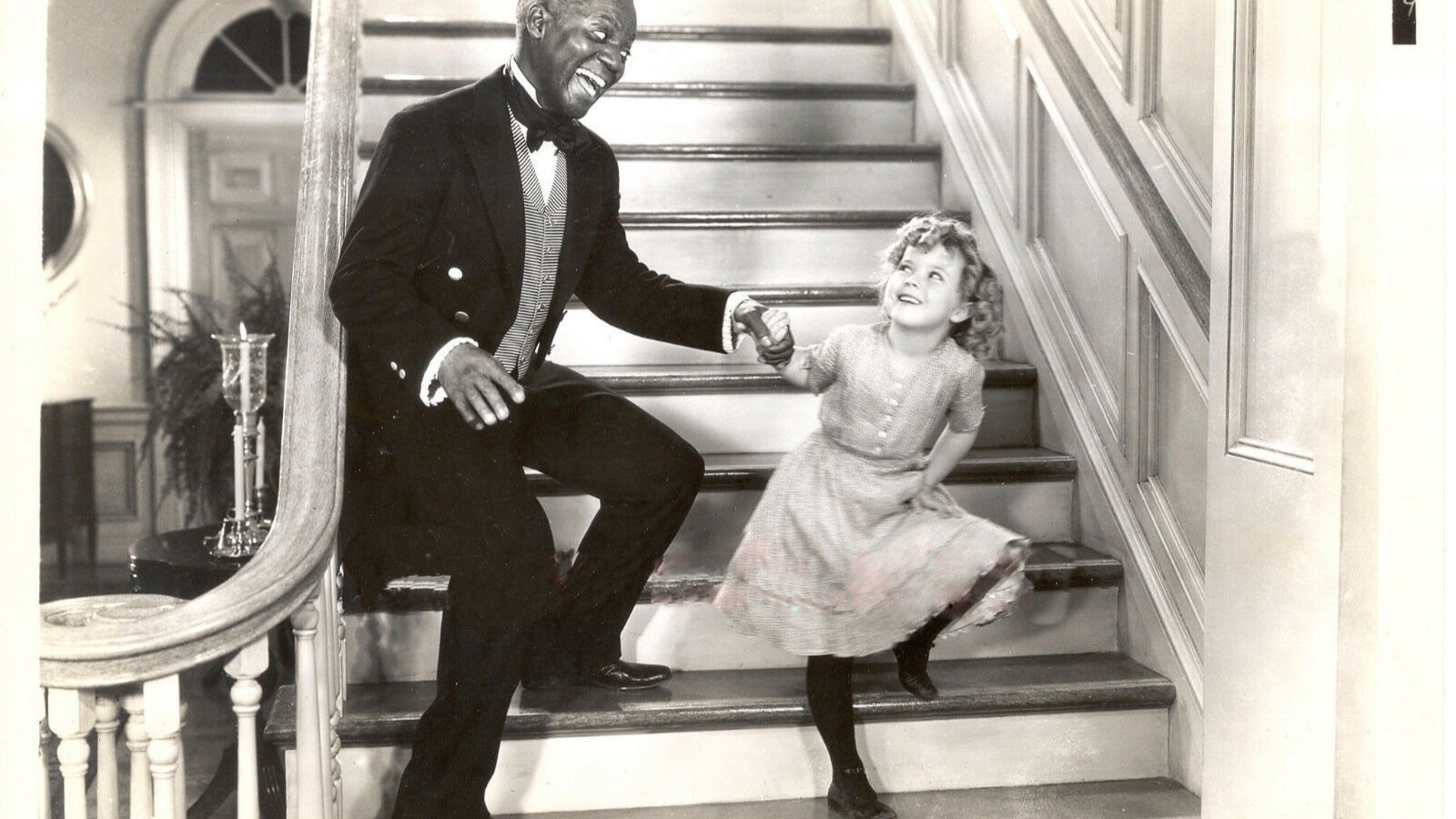
The viral version is easy to love: in 1935, Shirley Temple reached for Bill “Bojangles” Robinson’s hand while Hollywood hesitated, and a child’s innocence briefly broke through American racism. That version carries emotional truth, but it is too clean.
The stronger story is not that one child “didn’t see color.” The stronger story is that adults absolutely did. They built the film industry, the theater market, Southern exhibition rules, and Black performers’ contracts around that fact.
The scene comes from The Little Colonel, a Fox Film release from February 22, 1935, directed by David Butler and starring Shirley Temple, Lionel Barrymore, Evelyn Venable, Bill Robinson, and Hattie McDaniel. The American Film Institute records Robinson in the cast as Walker and McDaniel as Mom Beck, inside a film adapted from Annie Fellows Johnston’s 1895 children’s novel.
Before Shirley, there was Bojangles
Bill Robinson was not a charming side character who became important because Shirley Temple danced beside him. He was already Bill “Bojangles” Robinson.
Britannica identifies Robinson, born Luther Robinson in Richmond, Virginia, on May 25, 1878, and deceased in New York on November 25, 1949, as a major American dancer of Broadway and Hollywood. Texas Public Radio’s NPR remembrance describes him as a star in his own right and notes the influence later dancers acknowledged in his tap work.
So when the staircase dance appears on screen, it should not be read as a child star generously sharing space with an anonymous Black elder. It is a master teacher carrying a child performer through a discipline he had spent decades refining.
That matters because Hollywood’s racial memory often reverses credit. It turns Black genius into atmosphere. It turns instruction into service. It turns mastery into sweetness.
What the public record supports about the hand
The public record supports a precise claim: Temple and Robinson held hands; that physical contact was controversial enough that Southern prints reportedly removed the staircase scene; and Temple later remembered Robinson as a serious teacher and friend.
The popular social-media claim that studio executives directly told Temple not to hold Robinson’s hand, and that she defied them during filming, should be handled carefully. It may circulate through oral retellings, but CultureUp’s current source trail is stronger when it says what the public record can support: the scene included hand-holding, and the hand-holding was enough to trigger regional censorship.
Temple’s own memory gives a different, more intimate version of the hand story. Golden Globes and Texas Public Radio both point to her later recollections of Robinson as a teacher, friend, and respected collaborator. That is meaningful, but it should not be flattened into “Shirley Temple didn’t see color.” Later accounts also make clear that Temple did not fully understand the racism Robinson faced when she was a child.
The film was not innocent
The staircase dance is tender. The film around it is not.
The Little Colonel is built around post-Civil War Southern reconciliation, with a former Confederate colonel, a disowned daughter, and a child whose charm repairs white family conflict. The New Yorker’s legacy essay points readers back to the racism in the source material and the limits of treating the film as innocent nostalgia.
Inside the film, Robinson plays a Black servant connected to the white household. Alastair Macaulay’s dance essay points to the billing hierarchy and the way the film could use Robinson’s brilliance while keeping his character socially subordinate inside the story.
That contradiction followed Robinson’s Temple films. Black audiences could recognize his work and still object to the kinds of roles Hollywood offered him. That does not erase Robinson’s artistry. It sharpens the point: Black performers often had to move through roles smaller than their genius, then leave behind work too powerful for the frame that contained it.
Shirley Temple was a child star, not the system
Shirley Temple was born in 1928 and became one of America’s defining child stars during the Great Depression. AFI records The Little Colonel production dates as late November 1934 to January 9, 1935, meaning Temple was six during filming.
That age matters. She was not a civil-rights strategist. She was not responsible for dismantling Hollywood racism. She was a child performer working inside a machine run by adults.
But she was also not empty symbolism. Robinson treated her seriously as a student. She later remembered learning rhythm from him and valuing the way he taught without talking down to her. That relationship, teacher and student, elder and child, Black artist and white child star, created something the camera could not fully reduce to stereotype.
What the dance preserved
The staircase sequence is not just famous because a Black man and a white child held hands. It is famous because it works.
Robinson does not simply dance near Temple. He shapes the scene around her capacity. She follows, listens, learns, and performs. He gives the scene its rhythm, balance, and grace. The result is a public record of Black technical mastery entering mainstream American cinema through a door that was never fully open.
The dance should not be remembered as a sweet exception to racism. It should be remembered as evidence of racism’s limits. Segregation could cut the scene from Southern prints, but it could not erase the fact that the scene existed. Hollywood could cast Robinson as a servant, but it could not make him look untalented. The billing could push him downward, but the camera kept the truth: the child was learning from him.
How CultureUp tells this story now
The internet version asks readers to cheer for innocence. CultureUp’s version asks readers to protect memory.
Bill “Bojangles” Robinson should not be reduced to “the Black man Shirley Temple held hands with.” He was a Black American master artist whose craft changed American dance, whose screen presence crossed a racial line Hollywood barely knew how to handle, and whose work was powerful enough that even a segregated market could not fully contain it.
Shirley Temple should not be turned into a savior. She was a gifted child performer who shared a real artistic bond with Robinson, learned from him, and later remembered him with respect. That is enough.
The uncomfortable truth is that the same country that smiled at their staircase dance also censored it. The same industry that profited from Robinson’s talent put him in servant roles. The same public that praised the cuteness of the scene often failed to name the Black mastery inside it.
The archive kept what segregation tried to cut.
Fact-check box
CultureUp keeps the viral-memory claim smaller than the public record unless stronger primary sourcing is added.
| Claim | Status | Source lane | CultureUp handling |
|---|---|---|---|
| The Little Colonel was released in 1935 by Fox Film Corp. and included Shirley Temple, Bill Robinson, and Hattie McDaniel in the cast. | Confirmed | AFI Catalog | Use as film-record context. |
| The staircase dance is identified as a landmark interracial dance sequence in Hollywood film history. | Confirmed | Turner Classic Movies / public film-history reporting | Use as film-history context, not as a full civil-rights claim. |
| Temple and Robinson’s hand-holding was controversial enough that Southern prints reportedly cut the scene. | Confirmed in public commentary trail | The New Yorker / Alastair Macaulay | Use as the core censorship claim, with attribution. |
| Studio executives specifically told Temple not to hold Robinson’s hand and she defied them during filming. | Use with caution | Viral social-memory lane unless a stronger primary source is added | Do not state as fact in CultureUp voice. |
| Shirley Temple did not see color. | Rejected as thesis | Interpretive slogan, not source discipline | Use the article's final frame: childhood affection inside an adult world of segregation. |
Source notes and correction path
This article uses public film records, media-history commentary, Robinson biographical context, Temple remembrance, and a reviewed public-domain image record. It does not use viral meme text as source evidence.
Readers can request corrections at /corrections or send source notes through /submit. Approved updates should revise this source-controlled CMS record and preserve visible media rights, source limits, and the careful distinction between documented public memory and viral retelling.